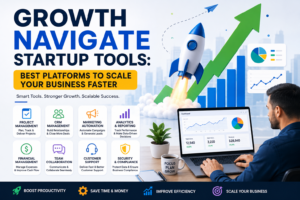
A startup’s success in today’s highly competitive business world is harder than ever before. founders must be able to accelerate their progress, grow quickly as well as manage remote teams. attract customers, streamline operations, and take the right decisions based on data, often with a limited budget. This is the reason the reason why growth-oriented startup tools are essential for modern-day entrepreneurs.
The best startup tools can will do more than automate routine tasks. They aid founders in streamlining their processes, enhance communication, study market behavior as well as strengthen relationships with customers and help to accelerate the pace of growth. In 2026, businesses who utilize the appropriate technology stack will have a huge competitive edge over companies that rely on manual systems or outdated processes.
No matter if you’re starting an SaaS business such as an eCommerce brand, financial technology platform or an online marketplace, knowing how tools for growth navigating startups perform can significantly enhance your operational efficiency.
This guide outlines the most essential tools for growing startups that can help businesses expansion, and what entrepreneurs must consider when creating the modern startup ecosystem.
Why Growth Navigate Startup Tools Matter More Than Ever
The startup market has evolved quickly over the past few years. Companies do not compete just in local markets. Small startups are operating worldwide from the beginning.
This places huge pressure on founders:
- Get faster
- Reduce the amount of waste from operations
- Know the customer’s behavior
- Increase the effectiveness of marketing
- Scale without causing excessive overhead
Growth Navigator startup tools address these issues by helping companies develop organized, measurable and adaptable systems.
Instead of relying on scattered workflows, startups can centralizedize operations and make better decisions by integrating digital tools.
This results in better efficiency, more satisfying customer experiences and faster business growth.
The Core Categories of Growth Navigate Startup Tools
Modern startup growth is dependent on a variety of operational areas working together efficiently. Different tools can support various areas of business.
The table below lists the most significant types of tools for growth startups in 2026.
| Tool Category | Primary Purpose | Startup Benefit |
|---|---|---|
| Project Management Tools | Create workflows and tasks | Enhances team productivity |
| CRM Platforms | Manage relationships with customers | Improves retention and sales |
| Marketing Automation Tools | Automated campaigns and outreach | Reduces time and increases conversions |
| Analytics Platforms | Measure performance | Enables data-driven decisions |
| Financial Management Tools | Track revenue and expenses | Improves forecasting and budgeting |
| Communication Tools | Increase collaboration | Supports hybrid and remote teams. |
| Customer Support Platforms | Manage inquiries and tickets | Improves customer satisfaction |
Each of these categories can contribute to sustainable growth of startups by enhancing the efficiency of operations and strategic decision-making.
Project Management Tools and Startup Productivity
One of the most difficult issues startups have is the chaos in their operations. Teams expand rapidly, responsibilities overlap, and priorities continually change.
Tools for managing projects help to manage workflows and ensure the operational clarity.
These platforms permit startups to:
- Assign responsibility
- Track deadlines
- Manage product development
- Coordinate teams
- Check the progress of your project in real-time
The advent of online working and teams distributed have made software for managing projects more crucial.
Successful startups do not depend on endless spreadsheets or disconnected communication threads. Instead, they utilize central methods that enhance efficiency and transparency.
The founders who invest in workflow management at an early stage tend to avoid problems with scaling later.
CRM Systems and Customer Growth
Customer relations are the basis of any successful startup.
Without systems for managing customers startups face challenges in retaining leads, monitor interactions and improve sales performance.
CRM platforms can help companies track:
- Customer journeys
- Sales pipelines
- History of communication
- Purchase behavior
- Retention patterns
Startups can provide more customized customer experiences, while also increasing the conversion rate.
Modern CRM tools integrate with marketing platforms, analytics dashboards and customer service platforms, creating a growing ecosystem.
In extremely competitive markets, customer intelligence is often an important asset for startups.
Marketing Automation and Scalable Growth
Marketing is among the biggest operational hurdles for startups at the beginning of their journey.
Founders have to draw visitors and nurture leads, increase brand recognition, and boost conversions, all while balancing a limited budget.
Marketing automation tools ease this process by taking care of repetitive tasks like:
- Email campaigns
- Lead nurturing
- Audience segmentation
- Social media scheduling
- Conversion tracking
- Customer engagement workflows
Automation boosts efficiency and allows startups to keep in constant contact with their customers.
By 2026, the concept of personalization will be a key growth factor. The latest marketing tools allow startups to create highly customized experiences based on customers’ behavior and preferences.
Companies that do not embrace automation frequently have a difficult time scaling their marketing campaigns efficiently.
Analytics Tools and Smarter Decision-Making
Companies that are driven by data always outperform companies who rely on assumptions.
Analytics tools can help founders see what’s doing well, what’s not working and what growth opportunities are available.
Modern startups make use of analytics to track:
- Traffic to websites
- User behavior
- Costs of acquisition for customers
- Trends in revenue
- Product engagement
- Marketing performance
This data allows businesses to improve their operations constantly.
In the absence of analytics, startup companies are at risk of making costly decisions based on inaccurate data.
Growth Navigator startup tools focusing on analytics give you the information needed to sustainably scale.
Financial Tools and Startup Stability
Many start-ups fail not because they don’t have enough customers, but rather because they have a poor management of their finances.
Problems with cash flow are among the main causes of collapses in startups around the world.
Tools for managing finances can help companies:
- Track expenses
- Monitor income
- Forecast growth
- Generate financial reports
- Manage invoices
- Improve budgeting accuracy
Modern financial platforms are also integrated with accounting systems and payment software, helping to reduce administrative work.
Founders who focus on financial transparency take better strategic decisions and minimize operational risk.
In times of uncertain economic conditions the need for financial clarity is more important.
Communication Platforms and Team Collaboration
Communication is at the heart of all startup businesses.
As startups expand and expand, communication gaps can lead to delays, miscommunications and productivity issues.
Teams can work together effectively through:
- Instant messaging
- Video conferencing
- File sharing
- Department channels
- Integration of workflows
Remote and hybrid work environments have made digital tools for communication essential.
The most successful startups design communications systems that allow for rapid decision-making, while ensuring transparency for the organization.
Insufficient communication infrastructure often slows down promising businesses.
Customer Support Tools and Brand Reputation
The customer experience directly influences growth in startups.
Firms with poor support systems typically lose customers even though their products are robust.
Tools for customer support improve customer service by coordinating questions and designing efficient workflows to respond.
These platforms aid startups to manage:
- Live chat systems
- Support tickets
- Customer feedback
- Knowledge bases
- Multi-channel support
Rapid and efficient support builds trust and boosts customer loyalty.
In 2026, customers will want immediate and smooth customer service. Startups who fail to live up to these expectations are at risk of damaging their reputation fast.
How Startups Should Choose the Right Tools
Every startup doesn’t need the same stack of technology.
Selecting tools solely based on popularity usually leads to excessive complexity and costs.
Founders must evaluate the tools used by startups based on:
Scalability
Does the tool allow for the long-term growth of your business?
Integration Capability
Does it work well with other platforms?
Ease of Use
Are employees able to adopt the system quickly?
Cost Efficiency
Does the price justify the investment?
Security Standards
Does the platform secure the privacy of sensitive customer and business data?
Reporting Features
Does the tool offer useful information?
The aim is not to utilize the largest number of tools. The aim is to build an environment that is streamlined and supports the efficiency of operations.
Most common mistakes that startups make with Growth Tools
Many start-ups invest heavily in software but do not realize the desired results.
This is because they are focused on the tools and not on strategy.
Common errors can include:
- Using a lot of disconnected platforms
- The company is not paying attention to the training of employees
- Failure to track the performance indicators
- Making sure that tools do not scale
- It is important to prioritize trends over demands
Technology should be used to support business goals and should not add complexity to processes.
Effective startups view instruments as enablers for strategic planning, not rapid solutions.
The Rise of Integrated Startup Ecosystems
One of the major trends for 2026 is the shift towards an integrated ecosystem of business.
Instead of relying on isolated software applications, startups increasingly choose platforms that bring various operational areas.
The benefits of integrated ecosystems are:
- Data consistency
- Automation of workflows
- Cross-department collaboration
- Customer visibility
- Efficiency of operations
For instance, a connected startup system might be connected to:
- CRM platforms
- Marketing automation
- Software for the financial sector
- Customer support systems
- Analytics dashboards
This results in a central operational infrastructure that enhances capacity and decision-making.
The future of growth in startups is becoming more connected and driven by data.
Why Startup Agility Depends on Technology Infrastructure
Agility is among the most important startup benefits.
Large corporations are often plagued by slow decision-making processes and inflexible processes. Startups are able to move faster since they can be more flexible.
But, agility needs operational support.
Growth Navigator startup tools aid companies:
- Launch campaigns quickly
- Respond to market shifts
- Test new strategies
- Rapidly analyze the results
- Enhance customer experiences
Without a modern infrastructure startups lose their dynamism advantage.
Technology allows startups to grow intelligently, while still allowing for speed and innovation.
Cybersecurity and Data Protection for Startups
As startups get ever more technological, the cybersecurity threats are increasing.
Many small-scale companies are unaware of security because they think cyber-attacks are only targeted at large corporations.
This assumption can be dangerous.
Startups manage valuable customer data as well as financial systems and intellectual property and operational information.
Insecure security systems can result in:
- Financial losses
- Trust issues with customers
- Legal issues
- Disruptions to operations
Modern startup software increasingly includes security features built-in, such as:
- Multi-factor authentication
- Communication encrypted
- Controls for access
- Monitoring of threats
- Secure cloud storage
Cybersecurity is no longer an option for companies that are growing. It’s a fundamental operational necessity.
The Importance of Automation in Startup Scaling
Manual processes ultimately stop startup growth.
As the business grows and founders have to manage each task on their own. Automation is essential to ensure scalability.
Automation tools help reduce the need for repetitive work in fields like:
- Marketing campaigns
- Customer at the time of their arrival
- Reporting
- Billing
- Team announcements
- Lead management
Startups can focus on strategy, innovation and customer relationships instead of managing tasks.
Effective automation increases efficiency while decreasing operational expenses.
In the competitive world, companies which automatize intelligently tend to grow quicker than companies that rely upon manual processes.
Future Trends in Growth Navigate Startup Tools
The landscape of startups is to evolve quickly.
A variety of significant developments are influencing the future of these growth-focused startup platforms.
Unified Business Dashboards
Startups increasingly favor centralized dashboards that integrate marketing, sales, analytics and operations in one interface.
Smarter Personalization
Modern platforms are now able to provide more customer-specific personalization as well as behavioral analysis.
Remote-First Infrastructure
Tools designed specifically to work with distributed teams have become the norm across different industries.
Predictive Analytics
Advanced forecasting capabilities allow startups to predict market changes and customer trends.
Low-Code and No-Code Platforms
These tools enable startups to create workflows and systems quicker without the need for a large technical resource.
Companies that can quickly adapt to the changing trends will most likely remain competitive for the long term.
Building a Sustainable Startup Growth Strategy
Tools alone do not assure success at startup.
Companies require an enlightened growth strategy, backed by the correct operational systems.
A sustainable growth strategy for startups includes:
- Clare business goals
- A solid operational workflow
- Customer-focused decision-making
- Technology infrastructure that can scale
- Financial discipline
- Performance analysis that is consistent
When the tools and strategies are in sync startups can run more effectively and grow with more confidence.
Successful founders concentrate on creating systems that promote sustainable long-term growth rather than quick-fix hype.
Conclusion
Tools to help startups grow are essential for the modern business model. In 2026, startups will face increased competition, growing expectations of customers and changing market conditions. Companies that are relying on outdated systems typically struggle to grow efficiently.
The best tools for startups increase efficiency communications, marketing effectiveness, financial visibility customer relations, as well as operational flexibility. In addition, they build the foundation needed for long-term sustainable growth.
Successful startups don’t simply make use of technology to improve their efficiency. They create networks that facilitate the strategic process of decisions and operational excellence.
The founders who select the most scalable combined, user-friendly and integrated tools can position their business to be more resilient and speedier expansion in a growing digital economy.
FAQs
What are the growth navigator startup tools?
Growth Navigator Startup Tools can be digitally-based platforms to aid startups to manage their operations the marketing process, data analysis and communications customers and businesses grow more effectively.
Why are tools for growing startups crucial in 2026?
The modern startup operates in highly competitive environments. Growth tools increase efficiency, automation customer interaction, making decisions that help businesses grow faster and more efficiently.
Which category of startup tools is the most relevant?
There isn’t a only one most significant category. Startups usually require a balanced ecosystem that includes project management and analytics, CRM marketing, communication as well as financial instruments.
What are the best ways for startups to choose most effective growth tools?
Startups must consider the scalability, user-friendliness and integration capabilities, as well as cost effectiveness, reporting capabilities and security standards prior to picking tools.
Small startups can profit from automated tools?
Yes. Automation helps small-scale startups get more time back, eliminate routine tasks, boost efficiency, and expand operations without dramatically increasing cost.