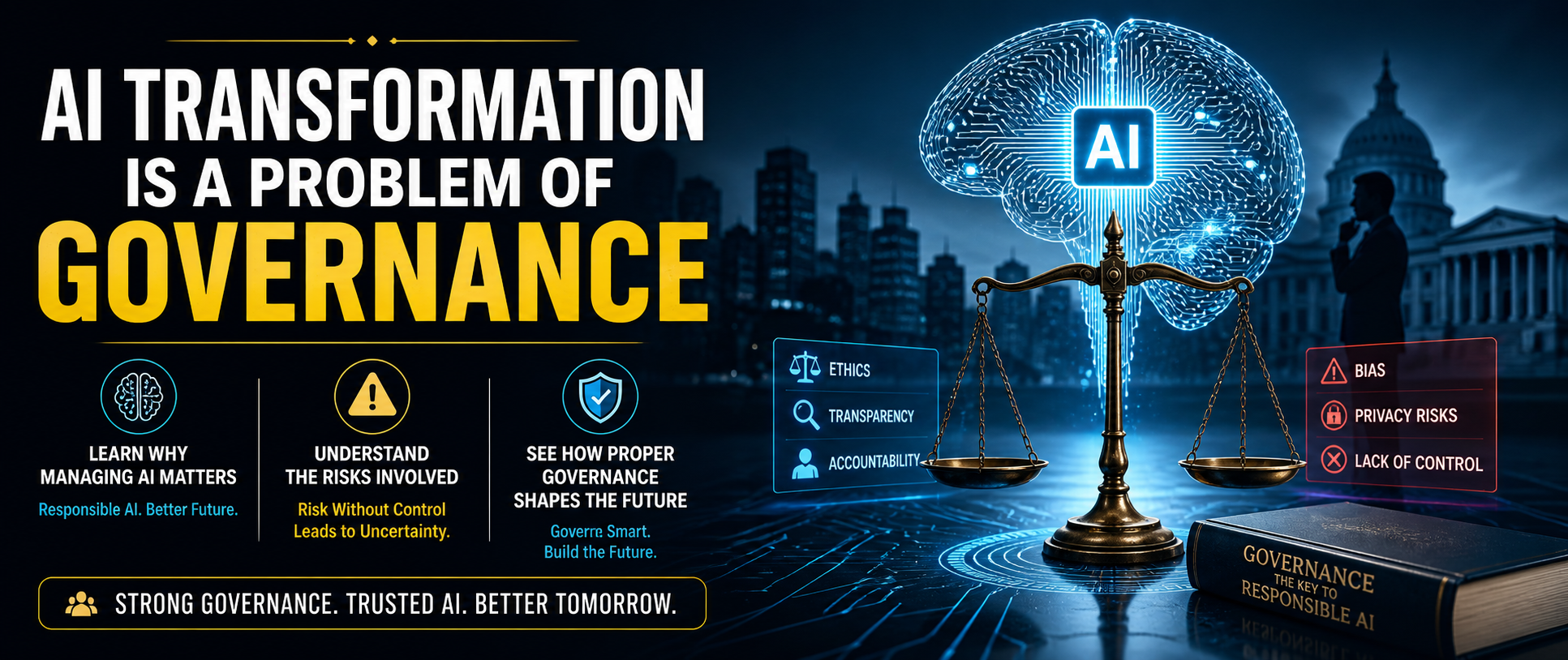
AI transformation is a problem of governance. Learn why managing AI matters, the risks involved, and how proper governance shapes the future. It is already changing the way businesses function as well as the way that decisions are made and the way society functions. From automated systems to predictive ones, AI is transforming nearly every industry.
However, as this process intensifies, a certain idea is becoming increasingly apparent:
AI transforms is the challenge of governance.
This statement doesn’t question the importance of AI. Instead, it points out the issue at hand. The issue isn’t just developing advanced systems but rather managing them properly. Technology is constantly evolving however the systems that regulate the use of technology often struggle to keep pace.
This guide will help you understand why governance is in the middle of AI transformation, what dangers are posed by this, as well as how businesses as well as societies can progress with a clear understanding and control.
What Does It Mean That AI Transformation Is a Problem of Governance?
If people claim they believe that AI change is an challenge of oversight, they’re in a way pointing out a gap between innovation and supervision.
AI systems are capable of processing massive amounts of data, impact decisions, and operate on a large scale. However, without clearly defined rules and accountability, as well as a organization, these systems may cause unintended consequences.
Governance is the term used to describe the policies, frameworks, and procedures to ensure that AI is employed in a safe manner. It covers anything from moral standards and ethical guidelines to compliance with the law as well as operational control.
In a nutshell, AI can do powerful things. But governance will decide if these things are conducted in a fair, safe and transparent manner.
Why Governance Matters More Than Ever in 2026
The importance of governance has expanded due to the fact that AI has become more than restricted to use in experiments.
It is now integrated into real-world systems:
- Recruitment and hiring processes
- Financial decision-making
- Healthcare analysis
- Interactions with customers
If AI has an impact on outcomes that impact life of people, risks get greater.
In the absence of governance, risks are increased. It can be difficult for decisions to justify. Bias can go unnoticed. The accountability of the company can be unclear.
The 2026 emphasis will no longer be solely on the latest innovations. It’s about the responsible implementation.
The Core Challenges of AI Governance
Understanding the reason why governance is so difficult can help explain why it is now the primary problem.
AI systems are complicated. AI systems learn through data and change with time, and typically perform in ways that aren’t immediately visible. This poses a number of challenges.
The first is the problem regarding the transparency. A lot of AI systems operate like “black boxes,” where the logic behind their decisions are difficult to comprehend.
There are two levels of responsibility. When an AI algorithm makes a choice that isn’t necessarily clear who is accountable for the result.
Thirdly, there is the issue of consistency. Different regions and organizations adhere to different rules, which makes it difficult to come up with unifying standards.
This makes governance not only necessary however, but also a challenge to implement successfully.
The Risks of Weak Governance
If governance is insufficient or absent, the effect of AI can be unpredictable.
Decisions could be influenced by bias data and result in unfair results. Personal information may be utilized in ways that cause privacy issues. Systems can operate without clear control, which increases the risk of mistakes.
In certain situations, companies might rely too much on automated decisions, without understanding how they’re taken.
These risks are not just hypothetical. They are present in real-world situations, which is why governing is considered to be essential.
Governance as a Foundation for Trust
Trust is a key factor in the way that individuals interact with technologies.
Users must be confident of the services they depend on are reliable, fair and honest. Without trust the adoption rate slows and resistance rises.
Governance is a key element to build trust. It makes sure the rules are clearly defined in place, that decisions are clearly explained and that accountability is in place.
If the governance system is in place Users will be more inclined to trust and use AI-driven systems.
The Role of Organizations in AI Governance
Businesses are at the cutting edge of AI change, and that implies that they are liable for a significant amount.
Companies must go beyond just taking on AI tools. They must develop structures that govern the way in which these tools are utilized.
This means setting up internal guidelines, making sure that they are in compliance with regulations, as well as creating clear lines of accountability.
It is also a continuous process of monitoring. AI systems aren’t static. They change and so their governance needs to change with them.
A Practical Framework for AI Governance
To ensure that governance is more effective companies can be focused on a systematic strategy.
Here’s a quick structure that highlights the essential components:
| Governance Area | What It Involves | Why It Matters |
|---|---|---|
| Transparency | Decoding the process by which AI decision-making is made | It builds trust and clarifies the situation. |
| Accountability | Determining who is accountable for the outcomes | Reduces risk and confusion |
| Data Management | Controlling the way the data collected is how it is used | Privacy is protected |
| Ethical Standards | Assuring fairness and avoidance of bias | Maintains Integrity |
| Monitoring | Monitoring system performance continuously | Avoids issues that can last for a long time. |
This framework demonstrates that governance isn’t an isolated event. It is a continuous process that affects every phase in AI use.
Key Benefits of Strong AI Governance
If governance is managed properly it can bring clear benefits.
It minimizes risk by making sure that systems function within established limits. It enhances decision-making through giving the structure and oversight. It also improves the reputation of the organization because stakeholders and users realize that accountability is viewed as a serious matter.
In addition, it allows an increase in productivity that is sustainable. AI will continue to grow however, in an environment that is controlled and secure.
The Balance Between Innovation and Control
One of the most difficult issues in governance is determining the balance that is right for you.
Too little control creates risk. Controlling too much could slow creativity.
The objective is not to impede the pace of progress, but rather to guide it. Governance that is effective allows companies to be innovative while also maintaining their responsibilities.
This balance is what will define the success of AI strategies for 2026.
The Global Dimension of AI Governance
AI is not restricted by boundaries, but it is typically governed by borders.
Different regions have their own ways of regulating. Some are focused on strict rules and others prefer flexibility.
This creates a complicated environment in which organizations have to navigate different frameworks.
The global cooperation trend is getting more vital. Standards that are shared can reduce confusion and help create more uniform methods.
How Governance Will Shape the Future of AI
In the future the future of governance is set to play an important role to AI transformation.
As technology advances the requirements for oversight will rise. New challenges will be identified as well as governance structures will have to evolve.
The focus will shift toward proactive strategies–anticipating risks rather than reacting to them.
This change will determine the way AI integrates into society in the long-term.
Final Thoughts
The notion the idea that AI transforms is actually a challenge to governance is a reflection of a change in the way we view technology.
The question isn’t about what AI is able to accomplish. It’s about how we can manage the things it does.
Governance is the foundation that transforms powerful tools into solid systems. Without it even the most advanced technology can lead to uncertainties.
Through AI, AI is something valuable –something that functions not only effectively, but is also responsible.
FAQs
What is the meaning of AI transforms are a challenge of governance?
This means that the biggest challenge is governing and regulating AI systems in a responsible manner.
What is the importance of governance in AI?
It guarantees fairness, accountability and safe usage of technology.
What happens if there isn’t AI Governance?
The risks increase due to bias, privacy concerns, and a lack of accountability.
What can companies do to enhance AI Governance?
Through setting clear guidelines in place, monitoring procedures, and making sure that transparency is maintained.
Does governance slow the pace of AI innovation?
It is not when it is done properly. It promotes sustainable and sustainable growth.